Want shorter queues and happier customers? Request a demo call.



How to Choose Clinic and OPD Queue Management Software in India
 Published
- By Kishan Shingala, CEO, Aarvi Technology
To choose clinic or OPD queue management software in India, first list what your front desk and doctors must do every day: take bookings, add walk-ins, show the queue and let the doctor call the next patient. Then check each product against a short checklist (patient channels, doctor schedules, one queue for booked and walk-in patients, waiting-room display, doctor app, reports and price) and test it on one doctor before you roll it out.
What a clinic needs from queue software
A clinic queue is different from a bank or a shop queue. Patients are often unwell, many are elderly, and some arrive without booking. Doctors also have their own hours and session lengths. The software has to cope with that, not just print a number.
- One queue per doctor that both booked and walk-in patients join, so nobody argues about who goes first.
- Patients who can see their turn on their own phone, so the waiting room is less crowded.
- Doctors who control the pace by marking each consultation as started and completed.
- A front desk that can still help a patient who has no smartphone or phones in to book.
A seven-point selection checklist
- Patient channels. Can patients book on the web without installing anything? Is there an app for those who prefer one? Ask exactly which channels exist today, including WhatsApp, SMS and QR codes, rather than which are planned. Our guide to WhatsApp and QR code token systems for clinics lists the questions to ask.
- Doctor schedules. Can each doctor have their own working hours, breaks, holidays and service times? Patients should see only slots that are really free.
- Booked and walk-in patients in one queue. Check that a patient who walks in can be added to the same queue as booked patients, and that a booking can be added by the front desk.
- Waiting-room display. Does the screen update on its own? Can it show more than one waiting area? Check which plan includes it.
- Doctor or assistant app. Can a doctor see the day's patients and mark each one started or completed from a phone? Accurate waiting times depend on it.
- Reports and feedback. Look for waiting times, patients seen per doctor, busy hours, cancellations and patient ratings. See how to manage the OPD queue in a hospital or clinic for the numbers worth tracking.
- Price, tax and trial. Ask how many doctors each plan covers, what extra doctors cost, whether the price includes GST and whether you can try it first. Our queue management system cost guide covers the hidden costs.
Health records and ABDM: ask before you assume
India's Ayushman Bharat Digital Mission (ABDM) is the national digital health programme. Under it, people can create an Ayushman Bharat Health Account (ABHA) number. According to a Press Information Bureau release, an ABHA is a unique health identifier in the form of a random 14-digit number, and creating one is voluntary. A July 2026 government factsheet says that in May 2026 over 100 crore health records were linked to more than 90 crore ABHA accounts.
Queue software and health records are separate jobs. If your clinic plans to work with ABDM, or with a hospital or clinic management system, ask each vendor in writing what they connect to today. Do not assume a queue system does it.
What E-Token Solution does for a clinic
These points come from the product pages on this site.
- Booking: patients book a token or a slot on the web with no install, or in the visitor mobile app, where they can also see which doctors are available, cancel or reschedule and track their token.
- One queue: booked and walk-in patients are served from the same queue, and front-desk staff or the doctor can add a booking for a patient who walks in or phones. See appointment scheduling.
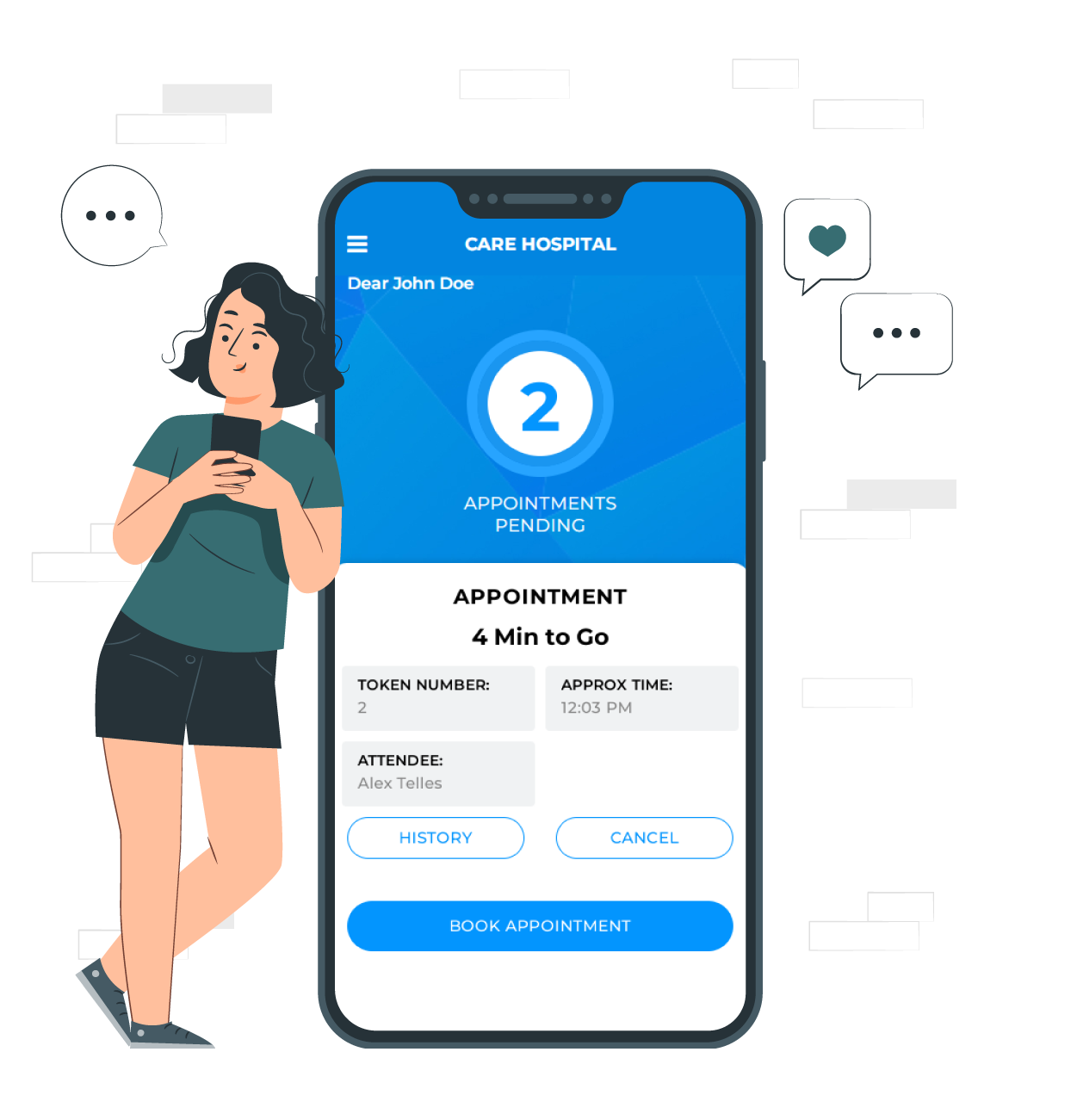
- Live tokens: each patient sees their number, queue position and estimated serving time, updated in real time.
- Doctor schedules: working hours, breaks and holidays can be set for each doctor or for the whole team in attendee management.
- Doctor app: in the attendee mobile app a doctor sees appointments, marks patients started and completed, and can create or cancel an appointment.
- TV display: the TV token display shows the current and upcoming tokens in the waiting area. It is included in the Business and Corporate plans.
- Reminders, ratings and reports: reminders about upcoming appointments go out by email and as push notifications in the visitor app. Patients are asked for a rating and review after each appointment, and reports cover queues, patient flow and service performance.
What E-Token Solution does not do
- Patients cannot book on WhatsApp, and reminders are not sent on WhatsApp. WhatsApp is used only for a one-time code that confirms a phone number at registration. QR code joining and SMS are not listed as confirmed features.
- Integration with a hospital information system or hospital management system is not a confirmed feature. The same goes for ABDM or ABHA: the site does not list it as a feature, so ask the sales team what is possible for your setup before you buy.
- It is queue and appointment software. It does not claim to be a patient record, billing or pharmacy system.
Test it on one doctor first
Run a trial with one doctor for a week, and judge it on four points:
- Could a patient with no smartphone still be booked in by the front desk?
- Did the estimated waiting times stay close to reality once the doctor marked each patient started and completed?
- Did patients stop crowding the desk to ask when their turn is?
- Was the doctor happy to keep using the phone app between consultations?
E-Token Solution has a Free plan with 1 attendee and the visitor mobile app, which suits a one-doctor test, and a 30-day free trial. Depending on the modules you choose, the support team can get you running within 2 hours and trains your staff on each module.
Which plan fits your clinic?
Plans are sized by attendees, and each doctor serving patients is usually one attendee.
- A single-doctor clinic: the Free plan includes 1 attendee.
- Up to 5 doctors: Basic, ₹2,100 ($30) a month.
- Up to 10 doctors, with a waiting-room TV: Business, ₹5,100 ($69) a month.
- Up to 20 doctors: Corporate, ₹9,100 ($125) a month.
Prices are before tax, and 18% GST is added for customers in India. Extra attendees cost ₹399 ($5) each on paid plans. See the pricing page for details or start a free trial. For worked examples, read the hospital appointment example scenario and the rural healthcare case study.
Frequently asked questions
What is the best queue management software for a small clinic in India?
The best one is the one that passes your own test. Check the seven points above with one doctor and your front desk. A small clinic can start on the E-Token Solution Free plan, which includes 1 attendee.
Do patients need to install an app?
No. With E-Token Solution, patients can book on the web. The visitor mobile app is there for patients who prefer it.
Does E-Token Solution work with ABDM or ABHA?
ABDM and ABHA integration is not listed as a confirmed feature. If you need it, ask the E-Token Solution sales team what is possible for your setup before you buy.
Can walk-in patients use it too?
Yes. Booked and walk-in patients are served from the same queue, and the front desk or the doctor can add a booking for a patient who walks in or phones.
Try it on your own queue. E-Token Solution has a free plan, and paid plans start at ₹2,100 or $30 a month.